Vibe Coding: Pros and Cons You Should Know
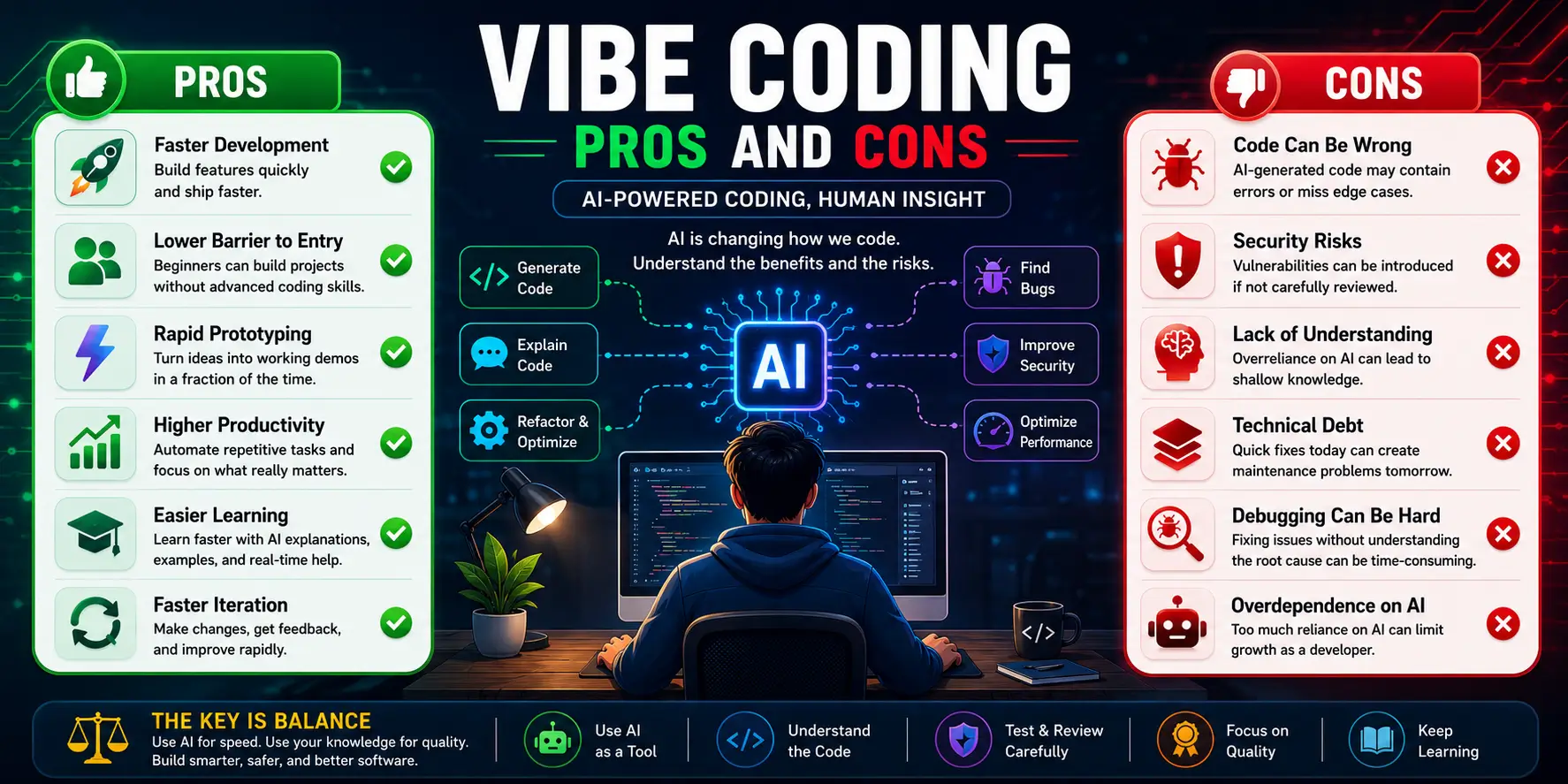
Explore the pros and cons of vibe coding, including its benefits, risks, productivity gains, security concerns, and impact on the future of software development.
Introduction
The way software is built is changing rapidly. With the rise of AI coding tools such as ChatGPT, GitHub Copilot, Cursor, Claude, and other AI-powered development platforms, people can now create applications by describing what they want in natural language rather than writing every line of code manually.
This approach is often called “vibe coding.”
Vibe coding means using AI to generate, modify, debug, and improve code primarily through natural-language instructions. Instead of spending hours writing code from scratch, a developer can explain the desired functionality, review the AI-generated output, test it, and continue refining it through prompts.
For experienced developers, vibe coding can dramatically increase productivity. For beginners, it can make software development much more accessible. However, it also introduces risks that should not be ignored.
Let's look at the major advantages and disadvantages of vibe coding.
What Is Vibe Coding?
Vibe coding is an AI-assisted approach to software development where the developer focuses more on what the software should do and less on manually writing every implementation detail.
For example, instead of writing hundreds of lines of code to create a login system, a developer might tell an AI:
“Create a secure login system with email verification, password reset, and Google authentication.”
The AI can then generate the initial implementation. The developer tests it, identifies problems, and asks the AI to make changes.
In simple terms:
Traditional coding: Think → Write code → Debug → Test → Improve
Vibe coding: Think → Describe → AI generates code → Test → Give feedback → Improve
The developer still needs to understand the application, requirements, testing, and security—but AI handles much of the repetitive coding work.
Pros of Vibe Coding
1. Faster Development
The biggest advantage of vibe coding is speed.
AI can generate boilerplate code, components, database queries, API integrations, validation logic, and other repetitive tasks within seconds.
A feature that might traditionally take several hours to implement can sometimes be created in a much shorter time.
This is particularly useful for startups and small development teams where resources are limited.
2. Lower Barrier to Entry
Vibe coding makes software development more accessible to people who don't have extensive programming experience.
Someone with an idea can use AI to create a basic website, prototype, automation, or application without first spending months learning every programming concept.
This doesn't mean programming knowledge is no longer useful. Instead, the barrier to starting a project becomes much lower.
3. Rapid Prototyping
Vibe coding is extremely useful when testing an idea.
Suppose an entrepreneur wants to build a marketplace but isn't sure whether customers will use it.
Instead of spending months building the complete platform, they can use AI to create an MVP quickly, launch it, collect feedback, and decide whether further investment makes sense.
This can significantly reduce the cost of experimentation.
4. Increased Developer Productivity
Experienced developers can use AI as a coding assistant.
AI can help with:
- Boilerplate code
- Documentation
- Unit tests
- Refactoring
- Debugging
- SQL queries
- API integration
- Regular expressions
- UI components
- Code explanations
Instead of spending time on repetitive tasks, developers can focus on architecture, business logic, user experience, and solving complex problems.
5. Easier Learning
Vibe coding can also become a learning tool.
A beginner can ask AI:
“Explain this React component line by line.”
or:
“Why is this Laravel query returning an error?”
The developer can immediately see examples and explanations related to the actual project they are working on.
This makes learning more practical and project-oriented.
6. Faster Iteration
Software development rarely works perfectly on the first attempt.
With vibe coding, developers can quickly experiment with different approaches.
For example:
“Make this dashboard more mobile-friendly.”
Then:
“Add a search filter.”
Then:
“Improve the loading performance.”
Then:
“Change the design to a cleaner modern interface.”
This rapid feedback loop makes experimentation much easier.
Cons of Vibe Coding
1. AI-Generated Code Can Be Wrong
One of the biggest risks is assuming that AI-generated code is automatically correct.
AI can produce code that:
- Doesn't handle edge cases
- Contains logical errors
- Uses outdated approaches
- Has performance problems
- Breaks existing functionality
- Introduces security vulnerabilities
The code may look professional while still being fundamentally wrong.
That's why testing and code review remain essential.
2. Security Risks
Security is one of the biggest concerns with uncontrolled vibe coding.
AI may generate code containing vulnerabilities such as:
- SQL injection
- Cross-site scripting
- Broken authentication
- Insecure file uploads
- Poor authorization
- Exposed API keys
- Improper data validation
A beginner who doesn't understand security may unknowingly deploy vulnerable code.
For small experiments, this may be manageable. For applications handling payments, personal information, healthcare data, or financial information, it can become a serious problem.
3. Lack of Understanding
A developer can build an application without fully understanding how it works.
This creates a dangerous situation:
The application works—but the developer doesn't know why.
When something breaks, the developer may repeatedly ask AI to fix the problem without understanding the underlying cause.
This can lead to increasingly complicated code and a project that becomes difficult to maintain.
4. Technical Debt
Vibe coding makes it easy to add features quickly.
But fast development can create technical debt.
For example, a developer might ask AI to solve ten individual problems. Each solution works independently, but the overall architecture becomes inconsistent.
Eventually the project may contain:
- Duplicate code
- Unnecessary dependencies
- Poor architecture
- Inconsistent naming
- Complex components
- Difficult-to-maintain logic
At some point, developers may need to rewrite significant portions of the application.
5. Debugging Can Become Difficult
AI can fix many bugs, but AI-generated fixes can sometimes create new bugs.
A common pattern is:
Bug → AI fix → New bug → AI fix → Another bug
Without understanding the underlying system, developers can end up patching symptoms instead of solving the actual problem.
6. Overdependence on AI
Perhaps the biggest long-term risk is becoming completely dependent on AI.
If a developer cannot understand basic programming concepts, they may struggle when:
- AI generates incorrect code
- The application behaves unexpectedly
- A production server fails
- A third-party API changes
- A security issue appears
- The AI cannot identify the root cause
AI should therefore be treated as a tool, not a replacement for technical understanding.
Vibe Coding vs Traditional Coding
The real question isn't whether vibe coding is better than traditional coding.
The better question is:
Where should AI be used, and where should human expertise remain essential?
| Area | Traditional Coding | Vibe Coding |
|---|---|---|
| Development speed | Moderate | Very fast |
| Learning barrier | Higher | Lower |
| Prototyping | Slower | Faster |
| Boilerplate work | Manual | AI-assisted |
| Code understanding | Usually high | Can vary |
| Security | Developer-controlled | Requires careful review |
| Large systems | Structured | Needs strong oversight |
| Experimentation | Slower | Very fast |
| Maintenance | Usually predictable | Depends on code quality |
Is Vibe Coding Bad for Programmers?
Not necessarily.
In fact, vibe coding may make good programmers even more productive.
A skilled developer can use AI to handle repetitive implementation while focusing on higher-level problems such as:
- System architecture
- Database design
- Security
- Scalability
- Performance
- User experience
- Business requirements
The programmer's role may gradually shift from simply writing code to designing, reviewing, testing, and directing software systems.
The Best Approach: Hybrid Coding
The most effective approach is probably not “AI instead of coding.”
It is AI + programming knowledge.
A developer should be able to:
- Explain what they want to build.
- Ask AI to generate an initial implementation.
- Read and understand the generated code.
- Test the functionality.
- Check security and performance.
- Debug problems.
- Refactor poor code.
- Make architectural decisions independently.
In other words:
Don't blindly trust AI-generated code. Understand what you are building.
Conclusion
Vibe coding is changing software development by allowing people to turn ideas into working software much faster.
Its biggest strengths are speed, accessibility, rapid prototyping, and productivity. Its biggest weaknesses are security risks, poor code quality, technical debt, and overdependence on AI.
Vibe coding is neither the end of programming nor a magic replacement for developers.
Instead, it represents a new development workflow.
The developers who benefit most from it will likely be those who combine AI's speed with human understanding.
The future may not belong to people who can write the most code.
It may belong to people who can understand problems, communicate clearly with AI, evaluate its output, and build reliable software from it.
0 Comments
Be the first to share your thoughts.